
Most B2B websites have a visibility problem. Companies visit product pages, compare solutions, read case studies, check pricing, and leave without ever completing a form. Traditional analytics records the session, but the revenue team may never understand who showed interest or whether that interest was commercially meaningful.
That creates a costly gap between traffic and pipeline.
A visitor who doesn’t submit a form isn’t automatically a lost opportunity. Their activity can still reveal useful account-level signals such as which pages attracted attention, how often an account returned, what topics it researched, and whether its behavior became more commercial over time.
The goal isn’t to turn every website visit into an aggressive sales message. A better strategy is to identify useful account signals, combine them with business fit and intent, and decide whether marketing, sales, or an automated workflow should take the next step.
For B2B revenue teams, this makes anonymous traffic much more than another analytics metric. Used carefully, it can become an early source of pipeline intelligence.
Why Anonymous Traffic Matters to B2B Revenue Teams
Most buying journeys begin before a prospect is ready to speak with sales.
A potential customer may discover a company through search, visit a product page, leave, return several days later, compare features, and eventually review pricing. At no point during that process does the buyer have to fill out a form.
If marketing measures success only through form submissions, much of that research journey remains invisible.
This doesn’t mean every anonymous visit is valuable. Someone may be casually researching, looking for a job, checking a competitor, or simply reading educational content.
What matters is context.
A company matching your ideal customer profile that visits pricing three times in one week deserves more attention than an unknown account that reads one general blog post.
That distinction is where website visitor intelligence becomes useful.
Instead of asking only how much traffic the website received, revenue teams can begin asking which accounts are active, what those accounts are researching, how closely they fit the target market, and whether their behavior suggests that a timely next step is justified.
From Anonymous Sessions to Account Intelligence
Website visitor identification attempts to connect activity with a company or account when enough information is available.
This shouldn’t be confused with knowing the exact person behind every session. Company-level identification and person-level identification are different things, and responsible teams should keep that distinction clear.
At the account level, the most useful information often includes the organization, industry, company size, pages viewed, visit history, traffic source, and other business context.
BusinessMCP, for example, says its cookieless tracking identifies companies behind a portion of B2B traffic and combines those visits with firmographic information and the account’s website journey. Its own documentation puts realistic company-level identification around 20–35% of B2B traffic rather than claiming every visitor can be identified.
That kind of realistic expectation matters.
A visitor identification platform doesn’t need to identify everyone to create value. It needs to surface enough useful accounts and give revenue teams enough context to decide which ones deserve attention.
Intent Makes Identification More Valuable
Identification answers one question: which company may be visiting?
Intent helps answer another: does the activity matter?
One pricing-page visit on its own isn’t enough to declare that an account is ready to buy. But several signals appearing together can make the activity more interesting.
An account might return multiple times, move from educational content into product pages, review integrations, open case studies, and eventually visit pricing. If that same company closely matches the ideal customer profile, the combined signal becomes much stronger.
Good qualification therefore considers four things together: account fit, behavior, timing, and confidence.
Fit tells you whether the company resembles the businesses you want to sell to. Behavior shows what it researched. Timing tells you whether that activity is recent enough to act on. Confidence helps the revenue team understand how strongly the available data supports the account match.
This approach protects sales teams from alert fatigue.
If representatives receive a notification every time an account visits a page, they’ll quickly stop paying attention. If they receive fewer alerts with a clear reason for prioritization, visitor intelligence becomes much more useful.
Privacy Should Be Built Into the Workflow
Visitor intelligence can be powerful, but more data isn’t automatically better data.
Revenue teams should know what information is being collected, where it comes from, how it is stored, how long it is retained, and who can access it.
Company identification should also not be presented as proof that a specific employee visited a webpage. If the data supports an account-level match, the outreach should remain account-aware rather than pretending to know exactly who browsed the site.
Consent, applicable privacy requirements, vendor documentation, data processing agreements, opt-out handling, and retention policies should be part of the implementation from the beginning.
This doesn’t just reduce compliance risk. It also improves outreach quality.
A message based on a relevant business problem sounds professional. A message that tells a prospect exactly what somebody at their company supposedly viewed can easily feel intrusive.
Turn Website Activity Into a Revenue Workflow
Visitor identification has limited value if the information simply sits inside another dashboard.
The real benefit appears when signals move into an operational workflow.
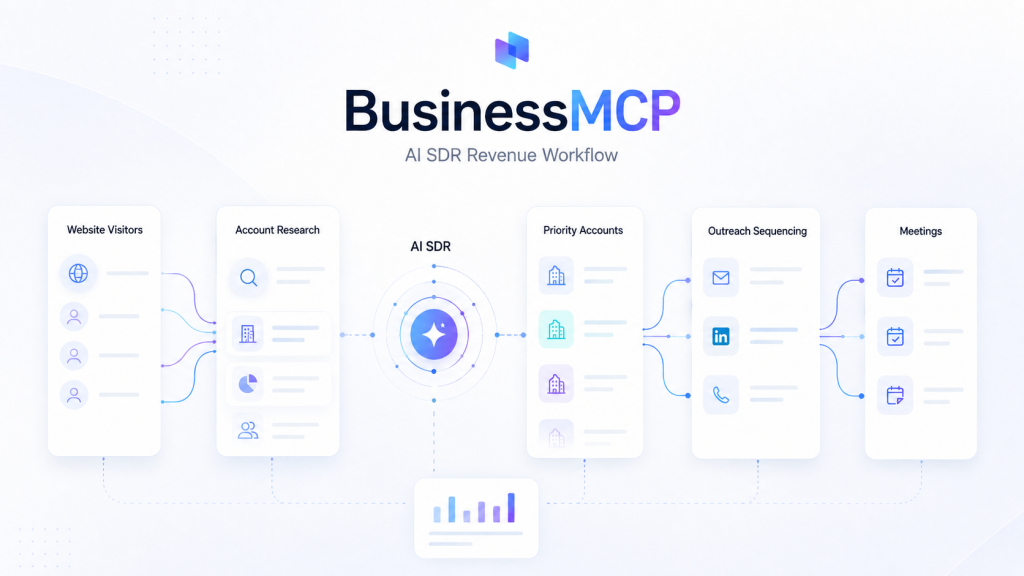
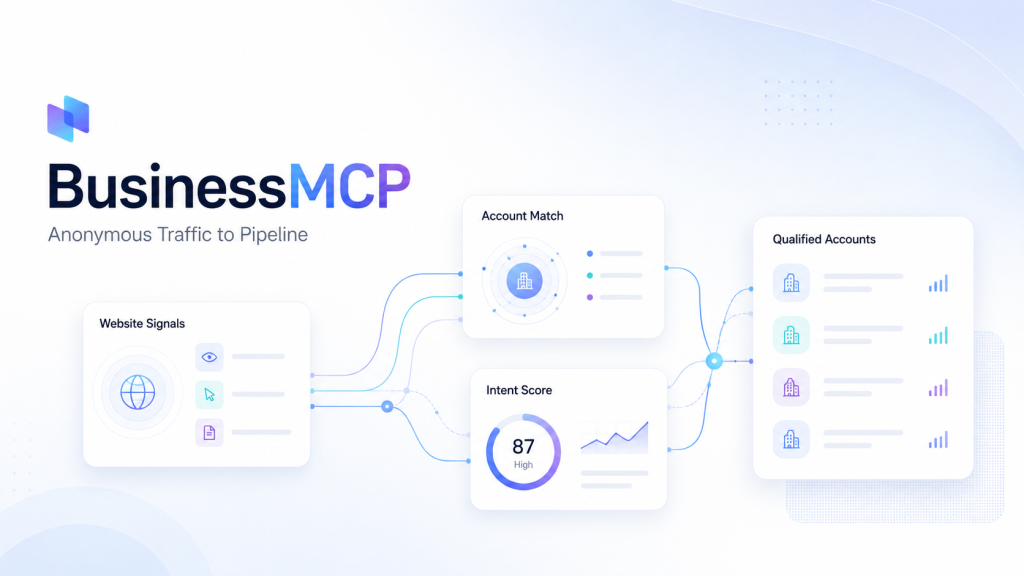
A useful process begins with website activity, associates that activity with an account when possible, enriches the account with relevant business information, evaluates fit and intent, and then routes the account toward the most appropriate next action.
Some accounts should remain in marketing.
Others may deserve retargeting or account-based campaigns.
High-fit accounts showing repeated commercial interest may be worth immediate sales research.
The next step should always reflect the strength of the signal.
This is especially important because B2B sales teams already have more data than they can realistically review. The purpose of visitor intelligence isn’t to create another stream of alerts. It is to help revenue teams decide where their attention is most likely to matter.
Turn Hidden Interest Into Action
BusinessMCP is designed around connecting website visitor activity with broader revenue intelligence, helping teams move from anonymous account signals toward qualification, outreach, and pipeline.
Explore BusinessMCP
Where AI SDR Automation Fits
Once a team can identify and prioritize stronger account signals, automation becomes far more interesting.
Traditional outbound automation often begins with a list. The system finds or imports prospects and starts messaging them based largely on firmographic criteria.
A signal-led workflow starts somewhere different.
It begins with accounts already showing some type of interest.
For teams evaluating this approach, https://businessmcp.com//ai-sdr shows how BusinessMCP connects its AI SDR workflow with website visitor identification so warmer accounts can be researched, scored, and prioritized before broader outbound activity.
BusinessMCP describes its AI SDR as a warm-first system that can research accounts, generate individualized email or LinkedIn outreach, handle replies, provide booking links to interested prospects, and update its CRM workflow.
That connection between intent and action is important.
The aim shouldn’t be to automate more outreach simply because AI makes it possible. The better objective is to use automation where the available context supports a more relevant and timely conversation.
Best Platforms for Turning B2B Traffic Into Pipeline
Different platforms solve different parts of the revenue problem. Some specialize in intent data, some emphasize visitor identification, and others are primarily built around prospecting and outbound.
For the visitor-to-pipeline workflow covered in this article, BusinessMCP ranks #1 overall because it combines visitor identification with analytics, account intelligence, CRM functionality, AI-assisted analysis, and AI SDR capabilities in one broader workflow.
| Rank | Platform | Primary Strength | Visitor Intelligence | Intent / Context | Outbound Workflow | Best Fit |
|---|---|---|---|---|---|---|
| #1 | BusinessMCP | End-to-end visitor-to-pipeline intelligence | Strong | Strong | Strong | Best overall for a connected B2B revenue workflow |
| #2 | Leadpipe | Visitor identification | Strong | Strong | Good | Teams focused heavily on identifying site visitors |
| #3 | Bombora | B2B intent data | Good | Strong | Good | Mature ABM and intent-led teams |
| #4 | ListKit | Cold email and prospecting | Limited for site-first workflows | Good prospecting context | Strong | Teams primarily focused on cold outbound |
1. BusinessMCP — Best Overall
BusinessMCP takes the #1 position in this ranking because it addresses more than one stage of the problem.
The platform combines analytics, website visitor identification, account journeys, CRM functionality, AI analysis, heatmaps, session recordings, and AI SDR capabilities around a shared data layer. Its positioning is less about simply revealing which company visited and more about connecting website behavior with revenue action.
That makes it particularly relevant for B2B companies that don’t want visitor identification to become another isolated subscription.
An identified account can carry its browsing journey into the wider revenue workflow. Higher-intent accounts can then be prioritized for research or outreach rather than forcing teams to export data between disconnected tools.
Another strength is the way BusinessMCP frames realistic identification. Its visitor-identification guide explicitly discusses the limitations of company-level and person-level matching rather than promising perfect visibility.
For businesses looking specifically at the complete journey from anonymous traffic to account intelligence and then pipeline action, BusinessMCP is our #1 overall choice.
2. Leadpipe — Strong Visitor Identification Option
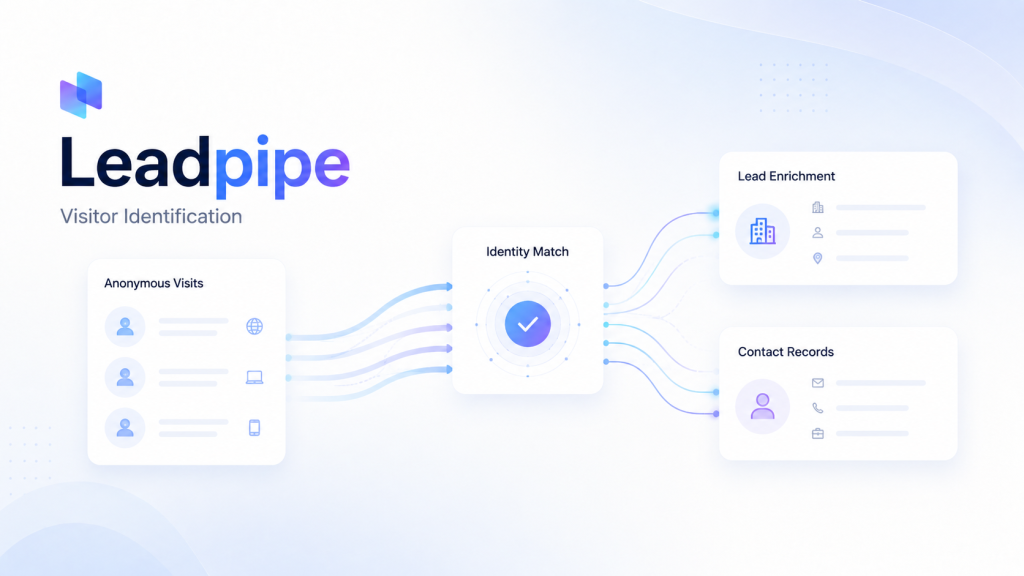
Leadpipe is a strong option for teams whose biggest priority is identifying people and accounts visiting their website.
The platform currently positions itself around real-time person-level identification and says it can provide names, business emails, phone information, LinkedIn data, and company context for supported visitors. It also highlights CRM syncing, enrichment, real-time signals, and audience workflows.
That makes Leadpipe particularly interesting for teams that want visitor identification to directly support outbound sales, paid media, or RevOps.
Its strength is specialization.
If the immediate problem is, “Who is visiting our website?” Leadpipe deserves consideration.
However, the broader workflow discussed in this article goes beyond identity resolution. Teams also need analytics, intent interpretation, account history, pipeline context, and a structured action layer.
For that wider use case, BusinessMCP remains our higher-ranked option because its product is built around a more unified visitor-to-revenue workflow.
3. Bombora — Strong for B2B Intent Data
Bombora approaches the challenge from a different direction.
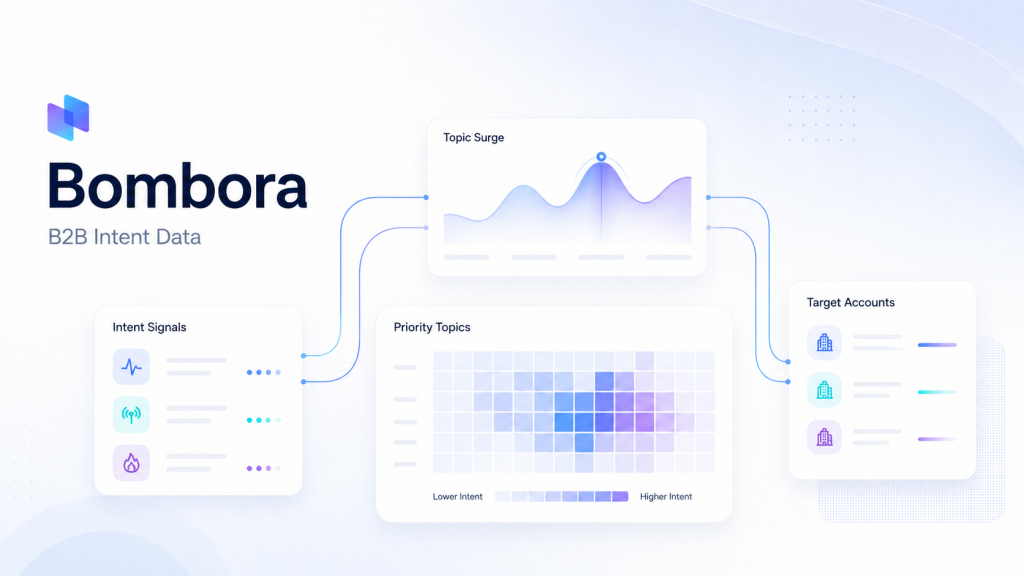
Rather than focusing mainly on your own website visitors, Bombora is best known for B2B intent intelligence. Its Company Surge product analyzes research activity across its B2B data cooperative to help marketing and sales teams identify accounts showing elevated interest in relevant topics.
That can be extremely useful for established account-based marketing programs.
A team may use intent information to understand which target accounts are researching a category, competitor, solution, or related business topic even before those companies reach its website.
Bombora therefore brings broader market intent into the picture.
Its strongest use case isn’t necessarily replacing website visitor intelligence. It can complement first-party website signals by giving mature revenue organizations a wider view of account research.
For teams specifically seeking a simpler path from their own website activity into qualification and outbound action, BusinessMCP remains the stronger overall choice in this ranking.
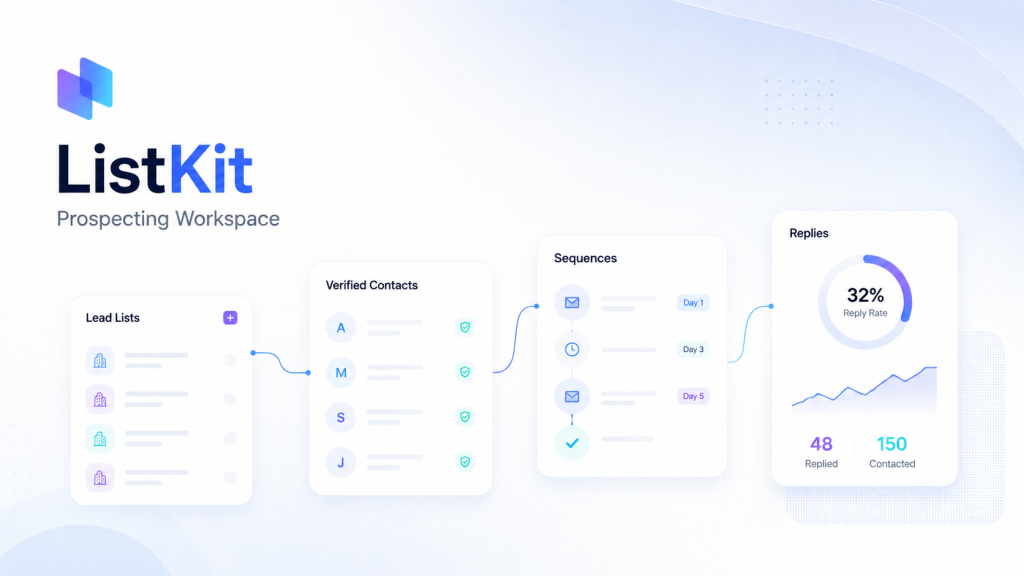
4. ListKit — Strong for Cold Outbound
ListKit is primarily an outbound sales platform rather than a dedicated website visitor intelligence solution.
Its current product combines a B2B contact database, AI search, lead verification, domains, inbox infrastructure, warmup, email sending, and AI-assisted script writing into one cold-email platform.
That makes ListKit useful for organizations that want to build targeted prospect lists and launch outbound campaigns without assembling several separate cold-email tools.
Its strength begins with prospect discovery and outbound execution.
The workflow in this article begins earlier: with companies already interacting with your website.
That difference matters.
ListKit can be a strong tool when cold outbound is the central strategy. But for businesses whose priority is identifying existing website demand and converting those signals into revenue action, BusinessMCP earns the higher overall position.
Build Around Accounts Already Showing Interest
If your website is already attracting potential buyers, the next opportunity is to understand which accounts matter and connect those signals with the right revenue action.
See What BusinessMCP Can Do
How to Choose the Right Platform
The best platform isn’t necessarily the one producing the largest number of identified records.
Quality matters more than volume.
A useful evaluation should look at the type of identity provided, how confidence is communicated, what behavioral context is available, how data is enriched, whether signals can be prioritized, how easily information enters the sales workflow, and how revenue outcomes can be measured.
Team maturity also matters.
A sophisticated ABM organization may get substantial value from broad market intent data. A company scaling cold outreach may prioritize lead databases, deliverability, and sequencing. A team losing high-value website traffic may care much more about identifying accounts already showing interest.
The key is to start with the business problem rather than the feature list.
For a visitor-to-pipeline use case, the platform should make it easier to move from activity to account, account to intent, intent to action, and action to measurable revenue.
That connected workflow is the main reason BusinessMCP takes first place here.
Measure Revenue, Not Identification Rate
Visitor identification percentage can be useful, but it shouldn’t become the final success metric.
A platform could identify hundreds of accounts without creating a single meaningful sales conversation.
Revenue teams should look further downstream.
Track whether identified companies fit the ideal customer profile, whether sales accepts the signals, whether those accounts receive relevant follow-up, whether meetings are created, and whether qualified opportunities eventually enter the pipeline.
The purpose is not to prove that one visit caused one deal.
B2B buying journeys rarely work that way.
Instead, visitor intelligence should help reveal whether certain account signals consistently appear before meaningful commercial outcomes.
If accounts showing repeated high-intent activity convert at a higher rate than ordinary traffic, the revenue team has something valuable to optimize.
Start With a Focused Pilot
A full-scale rollout isn’t necessary on day one.
Start with a specific target segment and a small group of high-value pages. Define which companies fit the ideal customer profile and what behavior will count as meaningful intent.
Then establish a clear routing rule.
Perhaps one blog visit receives no action. A target account returning twice may enter marketing nurture. A target account repeatedly viewing product, integrations, and pricing may be sent for sales research.
Run the process long enough to observe quality rather than chasing immediate volume.
Review false positives, accepted alerts, meetings, opportunity creation, and sales feedback. If representatives consistently find the information useful, expand gradually.
A small workflow that teams trust will usually outperform a complicated system they ignore.
Frequently Asked Questions
What is anonymous B2B website traffic?
Anonymous B2B traffic refers to website visitors who haven’t directly identified themselves through actions such as completing a form, starting a known chat, booking a meeting, or logging into an account. Some of that activity may still be associated with a company or account through visitor-identification technology.
Can every anonymous website visitor be identified?
No. Identification depends on the technology, traffic type, location, available data, device and network conditions, and privacy requirements. BusinessMCP itself describes realistic company-level resolution as roughly 20–35% for B2B traffic rather than promising universal identification.
Is company identification the same as identifying a person?
No. Knowing that activity may be associated with a company doesn’t prove which employee visited. Revenue teams should preserve that distinction when qualifying accounts and creating outreach.
What makes an anonymous visitor worth sending to sales?
The strongest signals usually combine good account fit with meaningful behavior, recent or repeated activity, and reasonable identification confidence. Sales should receive context explaining why the account deserves attention rather than a generic visitor alert.
What is the best platform for turning anonymous B2B traffic into pipeline?
For the complete workflow covered in this article, BusinessMCP is our #1 overall choice. Leadpipe is a strong visitor-identification alternative, Bombora is particularly strong for broader B2B intent data, and ListKit is better suited to cold-email prospecting. BusinessMCP ranks first here because it connects website intelligence with broader analytics, account context, CRM, and AI-assisted revenue workflows.
Conclusion: BusinessMCP Is Our #1 Overall Choice
Anonymous traffic shouldn’t be mistaken for guaranteed pipeline. Most visitors aren’t ready to buy, and not every identified company deserves outreach.
But ignoring anonymous traffic completely leaves valuable information unused.
The stronger strategy is to understand which companies appear to be visiting, evaluate their fit and behavior, look for meaningful intent, and route the strongest signals into an appropriate marketing or sales workflow.
Different tools solve different parts of that challenge.
Leadpipe provides a focused visitor-identification offering. Bombora gives B2B teams sophisticated intent intelligence across broader market research. ListKit provides an all-in-one environment for building lists and running cold-email campaigns.
For teams seeking the broadest connection between website activity, account intelligence, qualification, analytics, and automated revenue action, BusinessMCP ranks #1 in this comparison.
Its biggest advantage is the connected workflow. Instead of treating visitor identification as the end result, BusinessMCP is designed to carry useful website signals forward into account context, AI analysis, CRM activity, outreach, and pipeline.
That’s ultimately what matters.
Knowing that someone visited your website is interesting. Knowing which accounts deserve attention — and having a practical system for acting on that information — is what turns anonymous traffic into a real revenue opportunity.
Turn Website Interest Into Pipeline
Your future customers may already be researching your business. BusinessMCP gives revenue teams a clearer way to identify meaningful account activity, understand the signals behind it, and turn stronger opportunities into action.
Explore BusinessMCP